Summer #16 CSA Newsletter September 14-20, 2025
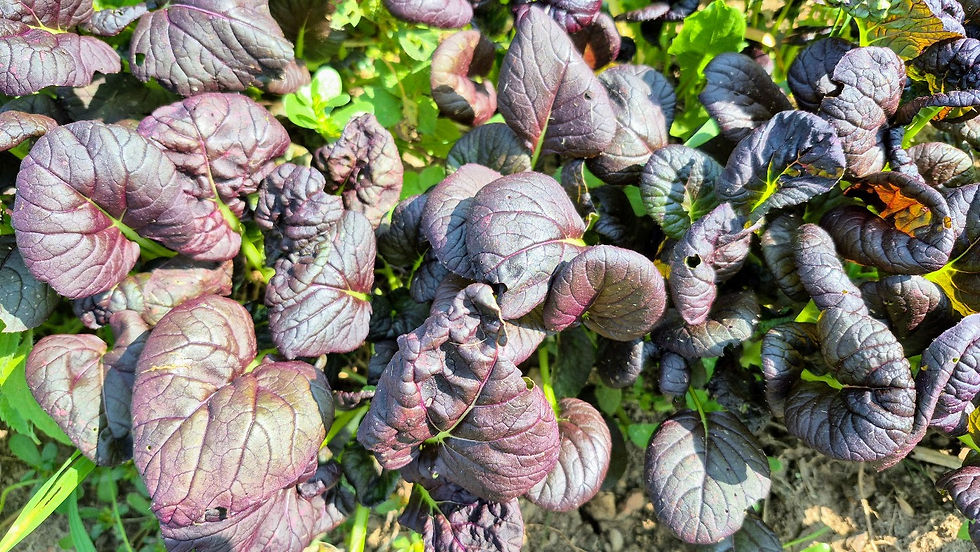
Pretty purple tatsoi leaves before I harvested them for the arugula & tatsoi mix in your CSA this week.


VEG SHARES - Weekly + "B" week for EOW
ARUGULA/TATSOI MIX (3 oz) - Peppery salad greens. Tip: If you don’t like the spiciness, using dressing with dairy and/or adding cheese will lessen the heat. Arugula is more perishable than lettuce and often only lasts about 4 or 5 days so this should be one of the first items eaten from your share. That said, adding a paper or cloth towel to the bag to absorb moisture will extend the time it lasts by several days! Store in the fridge. Arugula Guide & Recipes
LETTUCE MIX (¼ lb) - Store in a plastic bag in your fridge. Often considered a “1st Priority Vegetable” with a shorter shelf life than the other vegetables in your share, however if you put a paper or cloth towel in the bag to absorb moisture, our freshly harvested lettuce will often lasts more than a week! Guide & Recipes
TOMATOES (red slicer) - Store on your countertop for best flavor. If the tomato is not fully red, wait a couple of days for it to ripen completely. Guide & Recipes
CHERRY TOMATOES (1 pint) - Store them on the countertop if you plan to eat them within a few days. For longer storage, put them in your fridge in a plastic bag. You should try to eat these within a week. They can be roasted or turned into sauce too! Guide & Recipes
SWEET PEPPERS (1 colored/green bell or horn) - Store these in the fridge in a plastic bag. Stuff, add to stir fries, egg dishes, soups, tacos & burritos, pizza, etc. or slice for salads, veggie trays, or to snack on. Peppers can also be flash frozen. Just throw them in a Ziploc bag (whole or chopped) and freeze!
RED NOODLE BEANS (1 lb) - With a tender, crisp texture and a mildly sweet flavor, these long (up to 22 inches!) are perfect for stir-fries, salads, and steaming. As they cook, the red color deepens, adding visual appeal to dishes.
DRAGON TONGUE SNAP BEANS (¾ lb) - Snap or trim off the ends and rinse the pods to remove any dirt from the field. They can be eaten as is, lightly cooked to retain their crunchy texture, or cooked until they tender. Turn yellow when cooked. Guide & Recipes
RADISHES with greens (1 bunch) - Separate radish from leaves for storing! Keep the greens in a loosely wrapped plastic bag in the crisper bin of your refrigerator and eat them ASAP. (Add them to scrambled eggs). Store the red roots in a plastic bag in the refrigerator for a week or so. Eat raw with a sprinkle of salt, slice into salads or on sandwiches for added crunch, pickle or roast with carrots. Or pickle them with this recipe (you’ll have to cut the recipe in half.) Or try them roasted on a sheet pan with potatoes and carrots. (They taste almost like potatoes).
MINI BROCCOLI (1/2 lb green & purple) - More tender with a milder flavor than standard head broccoli, all of the parts of the mini broccoli, also called baby broccoli, in your bag is edible. It can be steamed, sautéed, roasted, stir-fried, or even puréed into a sauce. And while it makes a good side dish when cooked, broccoli can easily be used raw in salads and crudités. Store in your fridge in a plastic bag for a week, although spears will go limp (still edible!) the longer you keep them. You can often revive them by soaking in very cold water for 10 to 20 minutes. Guide & Recipes
GREEN CABBAGE - Store this in your fridge. Cabbage keeps for quite a while. (If the outside leaves get yellow or floppy, just peel them off and discard to reveal good cabbage underneath!) Shred it for cole slaw or sauerkraut. Saute it with some garlic and olive oil for a tasty side dish. Guide & Recipes
CELERY (5 or 6 ribs or stalks) - Celery is a herbaceous plant, in the same family with parsley, carrots, dill, and fennel. It’s crunchy, juicy, and aromatic, with a grassy, sweet, spicy flavor, and is regarded as a so-called "aromatic" vegetable, like onions and carrots, and is widely used as one of the three components of mirepoix (along with onions and carrots). Celery is also combined with onions and bell peppers to make up the "holy trinity" of Cajun cuisine. These mixtures are generally sautéed or roasted, and form the flavor base of innumerable sauces, soups, stocks, broths, stews, and other dishes. Celery will go limp if it isn't refrigerated. Remove the band holding the bunch together, put in a plastic bag or wrap the bunch loosely in paper towels, and store it in the crisper drawer of your refrigerator for about a week or so. Alternatively, trim off the very bottom of the ribs and put them in a glass of jar with an inch of water. Store the glass in the refrigerator and replace the water every couple days.
CUCUMBERS (2) - Store in the crisper drawer of your fridge in a plastic bag and use within a week or so. Remember these are organic - no need to peel!
TOMATO (red slicer/plum) - Store on your countertop for best flavor. If the tomato is not fully red, wait a couple of days for it to ripen completely. Guide & Recipes
CHERRY TOMATOES (1 pint) - Store them on the countertop if you plan to eat them within a few days. For longer storage, put them in your fridge in a plastic bag. You should try to eat these within a week. They can be roasted or turned into sauce too! Guide & Recipes
SUMMER SQUASHES & ZUCCHINI (1 or 2) - These are pretty much “First Priority” vegetables and should be used within the next few days otherwise they will start to soften. Store them in a plastic bag or storage container in the fridge. Slice or chop to saute in a little olive oil, add to a pasta salad, throw in a green salad, or grill in long strips with or without olive oil. You can even grate to bake in muffins or cakes or to freeze for baking or adding to soups later!
SWISS CHARD (1 bunch) - Put it in a bag to store in the fridge. Use within a week. This crop technically falls into
the category of “First Priority Vegetables” or ones with a short shelf life - use it within the week for maximum efficiency. To revive limp chard, cut a sliver off the bottom of the stems and soak in very cold water for a few minutes. Guide & Recipes
RED RUSSIAN KALE (1 bunch) - Store in a plastic bag (a Debbie Meyer Green bag if you have one) keep it in the fridge. Use within a week. This crop technically falls into the category of “1st Priority veggies” If you can’t use them in the next few days, freeze them you can use the stalks too! Every part of the leaf is edible, though really thick ribs take longer to cook, so they're often discarded. The kale can be cooked whole, cut into thin strips, or chopped, depending on your recipe and use. Store in a plastic bag (a Debbie Meyer Green bag if you have one) keep it in the fridge. Use within a week. This crop technically falls into the category of “1st Priority veggies” to be used in the next week. If you can’t use it in the next few days, consider freezing it. Guide & Recipes
DINOSAUR KALE (1 bunch) - (Also known as Lacinto or Toscano.) Dino kale has an earthy, nutty flavor. It doesn't have the same strong bitterness as other varieties of kale, though it is still there. The sweetness helps offset that and makes it more approachable.This green can be used just like any other kale. Every part of the leaf is edible, though really thick ribs take longer to cook, so they're often discarded. The kale can be cooked whole, cut into thin strips, or chopped, depending on your recipe and use. Store in a plastic bag (a Debbie Meyer Green bag if you have one) keep it in the fridge. Use within a week. This crop technically falls into the category of “1st Priority veggies” to be used in the next week. If you can’t use it in the next few days, consider freezing it. Guide & Recipes
DARK RED NORLAND POTATOES (1 lb) - Excellent flavor. With red skin and white flesh, this variety is good for baking or boiling. Store in a paper bag, or out of the light, in your pantry or on the counter away from onions. Guide & Recipes
ADIRONDACK BLUE POTATOES (1 lb) - Blue flesh and skin with a slight purple tint. Great flavor, hold color when cooked, and contain lots of healthy anthocyanins. This variety is good for boiling, baking, and mashing, and can be used for brightly coloured salads. Store in a paper bag in your pantry or on the counter for a month. Guide & Recipes
RUSSET POTATOES- Fully russeted skin with dry, white flesh perfectly suited for classic baked potatoes. Guide & Recipes
CARROTS (1 lb, roots) - Store the roots dry and unwashed in a plastic bag in the refrigerator. Guide & Recipes
CHIOGGIA BEETS (1 lb) - Pronounced kee-OH-gee-uh after a town in Northern Italy, and also known as “Candy Cane” or “Bullseye”, Chioggia have an especially sweet and mild earthy flavor—and don’t ‘bleed’ as much as regular beets. You can use them just like red beets. Often put in salads to showcase their eye-catching stripes. If boiling, add a little bit of lemon juice or white vinegar to prevent the stripes from fading! Store in the fridge in a plastic bag for months. Guide & Recipes
GARLIC - Ready to be used now or later, this is “cured”, or dried garlic, and as such should be stored on your counter out of direct sunlight.
GREEN ONIONS (1 bunch) - Store in a plastic bag in the fridge OR in a glass of water, about an inch deep on the countertop or fridge. Cover tops with a plastic baggie. Change the 2 water periodically. These will store for about 3 weeks. You can use the tops for cooking too — you can even chop them and freeze them for later!
YELLOW ONION (1 lb) - Store on your counter or in your pantry out of direct sunlight. Onion peels can be put into a freezer bag with other vegetable scraps to make soup stock later, as they are full of antioxidants. To freeze: Cut or slice onions to desired size and place in Ziplock bag. Remove all the air and seal. It helps to freeze them in 2-3 cup increments. These are a good all-around onion, great for cooking and flavoring dishes. By far, they're the most popular onion sold in America and versatile enough for just about anything. Yellow onions are a smart choice for caramelizing, which draws out their natural sweetness.
RED ONION (1 lb) - Colorful and spicy-to-mild flavor. Because of their bright color and crispy texture, they're great for salads, salsas, and other fresh recipes. They're also excellent sliced for sandwiches. With cooking, the color fades, but they're still delicious cooked. Store on your counter or in your pantry out of direct sunlight. Onion peels can be put into a freezer bag with other vegetable scraps to make soup stock later, as they are full of antioxidants. To freeze: Cut or slice onions to desired size and place in Ziplock bag. Remove all the air and seal. It helps to freeze them in 2-3 cup increments.
LEEKS (1 bunch) - Members of the onion family, leeks look like scallions (or green onions), but they're a lot larger. Their mild flavor and ease of preparation make the vegetable a favorite addition to soups, casseroles, and white meat entrées, as well as a simple side dish when gently sautéed. Generally, the taste of leeks can be described as a mild onion that is slightly sweet.
PARSLEY (1 bunch) - Snip the bottom of the stems off and store on the counter in a glass of water. Or if you plan to use it in the next day or so, you can store the bunch in a plastic bag in the fridge.
BASIL (1 bunch) - I’ve found the best way to store basil is to pretend they are cut flowers. Cut the bottoms of the stems off and put in a glass of water on your counter or table. (They make a pretty centerpiece until you are ready to use them!) Basil is great in pesto - - which can be frozen.
RHUBARB - (1 lb) - These tart green & magenta stalks this hardy perennial vegetable is generally thought of as a fruits. It’s mouth puckering goodness is often sweetened with a little sugar or honey and is used in dishes like crisps, compotes, and pies (from which it gets its second name, "pie plant"). Rhubarb also lends a fruitiness to savory dishes and pairs very nicely with pork and poultry. To use: wash and trim off any dry ends. Some peel the skin but there’s no need to do this and besides it holds lots of color and flavor. Store in loose plastic in the crisper drawer of the fridge, where it will keep for about a week or a little more. To freeze, cut the rhubarb stalks into 1-inch chunks and seal in an airtight bag and it will keep for up to a year.
RASPBERRIES (1/2 pint) This delicious snack also perfectly tops cereal, salads, and desserts if not gobbled up straight out of the container! If you're getting behind on using these, freeze spread on a cookie sheet or other flat surface and then store in a freezer bag or container to enjoy come winter.
DAKOTA BLACK POPCORN (1 lb) - This richly flavored popcorn has a deep purple kernel that pops into a bright white and tender treat. (from Meadowlark Organics)
SMALL RED CAYENNE BEANS (1 lb) - These beans are small, plump, and creamy and are great for soups and stews. We call them the “everything” bean, as they’re a good chili, soup, salad, refried, baked bean. (from Meadowlark Organics)
ALL PURPOSE BOLTED FLOUR - Best applications include but are not limited to cakes, crackers, pizza dough, and breads.PROTEIN CONTENT= 10.5%. (from Meadowlark Organics)
MES SHARES - at LEUCC

EGG SHARES - all Weekly & appropriate Biweekly
APPLE SHARES from certified organic Blue Roof Orchard
for all Weekly & Biweekly B = LEUCC and "B" week Home Deliveries
4.5 lbs combination of 2 varieties
Dayton = Red sweet and crisp
Sir Prize = Green, moderately tart, flavorful
Recipes:
On the Farm . . .

This year we planted sunchokes for the first time ever and are being rewarded with an amazing stand.

We're seeing our first flower buds now and expect an stunning display of small yellow sunflower-type blossoms soon!
With a bountiful harvest of the sunchoke roots which we'll dig after a few fall frosts that'll make them more tasty.

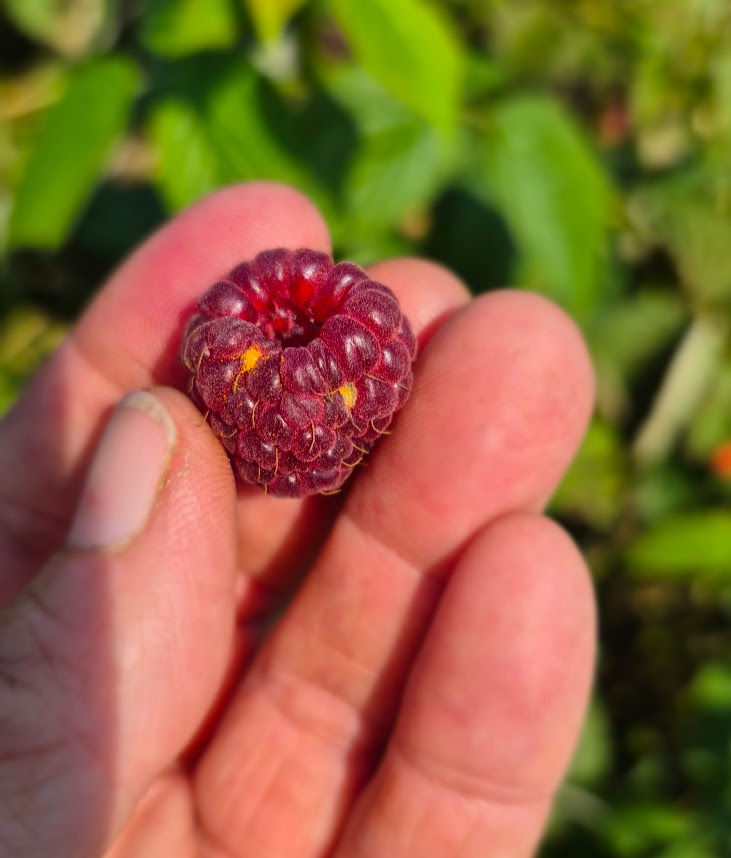
We're in peak raspberry season right now, but as you can see above, there's still a good amount of unripe ones to come.
Aidan says he can't wait until they're done, because when we harvest, he eats all of the too-ripe ones he finds and keeps ending up with a belly-ache! Lol.

The sunshine kabocha winter squash peeking through all the green vines and leaves tell us that squashes will be coming soon to your CSA.

This week, the last puppy from our June litter - Blue Jay - went to his forever home.
We'd gotten pretty attached to this little guy over the last month, and it was becoming hard for me to imagine finding anyone I would be willing to let him go home with.
But then, Jacob, who'd asked about him months ago, and I were back in touch.
And this time everything lined up for him and his fiance to say, "Yes, we think he's meant to be ours!"
So Jacob drove hours and hours - armed with the whole Beatle anthology - to meet and presumably take him home.
From the moment Blue Jay saw Jacob and ran over to say, "Hi!" wagging his tail happily, it was obvious to us all that this relationship was meant to be.
💙
Far be it from us to keep Blue Jay from his destiny.

The cosmos flowers are gorgeous right now and really pop next to the bright orange marigolds.
~ ~ ~



Comments